
Six Business Models. One Platform That Actually Fits Yours.
Real-money, crypto-native, social, sweepstakes, skill-based — built around the business you're running, not retrofitted onto one you're not.
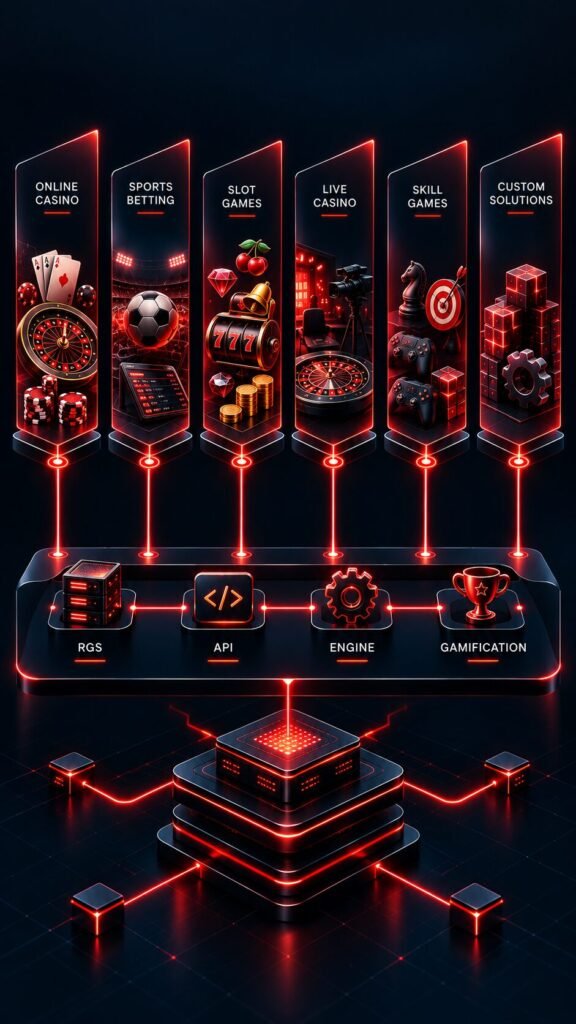
Most iGaming platform development gets sold as one rigid template with a different logo bolted on. That's how operators end up compromising their business model to fit someone else's architecture. Kaushik Bhatti builds the platform around the vertical you're actually running: Online Casino, Crypto Casino, Social Casino, Sweepstakes, Skill Gaming, or something fully custom; on top of the RGS, aggregation, engine and gamification layers that already work together.
iGaming Technology & Solutions RGS (Remote Gaming Server) Gamification Game Engine iGaming Platforms Casino Games Slots Originals Skill Games Instant Games Crash Games Live Games Table Games Custom-built Games iGaming Technology & Solutions RGS (Remote Gaming Server) Gamification Game Engine iGaming Platforms Casino Games Slots Originals Skill Games Instant Games Crash Games Live Games Table Games Custom-built Games iGaming Technology & Solutions RGS (Remote Gaming Server) Gamification Game Engine iGaming Platforms Casino Games Slots Originals Skill Games Instant Games Crash Games Live Games Table Games Custom-built Games
engineering the future of igaming. engineering the future of igaming.
Pick the Platform That
Matches How You Actually Make Money
Online Casino
Real Money, Real Infrastructure.
What it solves:
Launching real-money casino means every layer: payments, KYC, licensing-ready architecture, game supply; has to hold up to regulatory and player scrutiny from day one, not get patched in after launch..
What you get:
A complete real-money platform: accounts, payments, compliance-ready architecture and game supply; built to launch without reinventing the infrastructure underneath it.
Crypto Casino
Built Crypto-Native, Not Crypto-Bolted-On.
What it solves:
Most "crypto-ready" platforms are a traditional casino with a wallet plugin duct-taped on: slow settlements, clunky UX, and a payments team that clearly built for fiat first.
What you get:
Blockchain-powered gaming with crypto payments and modern wallets built into the architecture itself, not added as an afterthought.
Social Casino
Entertainment First, No Real-Money Baggage.
What it solves:
Real-money casino architecture forced onto a social/free-to-play product means carrying licensing overhead and compliance weight you don't actually need, and a player experience built for the wrong incentive.
What you get:
Entertainment-first experiences engineered around engagement and retention, not real-money risk management.
Sweepstakes Casino
Compliant By Design, Not By Retrofit.
What it solves:
Sweepstakes models operate under a completely different legal structure than real-money casino: dual-currency logic, prize-entry mechanics, and compliance requirements that a standard casino platform wasn't built to handle.
What you get:
Purpose-built sweepstakes architecture: dual-currency wallets, compliant entry mechanics; ready for fast-growing regulated markets.
Skill Gaming
Where the Best Player Actually Wins.
What it solves:
Skill-based platforms need fair, verifiable competitive infrastructure: rankings, anti-collusion logic, tournament structures; that generic casino platforms simply don't have.
What you get:
Competitive real-money and social formats with tournaments, rankings and progression systems built for skill-based fairness, not chance-based math.
Custom Platform
When None of the Above Fits.
What it solves:
A genuinely new business model doesn't fit neatly into an existing category, and forcing it into one of the above just means shipping compromises from day one.
What you get:
A tailored platform ecosystem, architected from concept to live launch around exactly what the business model actually requires.
Every Vertical Runs on the Same Core Stack
Regardless of which business model above fits, every platform is assembled from the same four components; this is what actually makes it possible to launch fast and pivot verticals later without a rebuild:
- RGS — the game logic and session layer underneath everything.
- API Aggregation — outside content connected in through one integration, not per-vertical rework.
- Game Engine — new titles built and deployed the same way regardless of the vertical wrapped around them.
- Gamification — missions, tournaments, and retention mechanics that work whether the currency is real money, crypto, sweepstakes entries, or social credits.
Match Your Business Model
to the Right Platform
Online Casino
If your business is Traditional real-money casino, regulated market
Crypto Casino
If your business is Crypto-first or crypto-adjacent audience
Social Casino
If your business is Free-to-play, engagement over wagering
Sweepstakes Casino
If your business is US-facing or sweepstakes-legal market entry
Skill Gaming
If your business is Competitive, skill-based real-money format
Custom Platform
If your business is Something none of the above quite describes
Frequenty Asked Questions.
Yes, because every platform shares the same RGS, aggregation, engine and gamification foundation, adding a second vertical later is an extension of the existing architecture, not a separate rebuild.
Yes, significantly — each operates under a different legal and regulatory structure, which is exactly why the architecture is purpose-built per vertical rather than one generic template with a currency toggle.
That's what Custom Platform is for; most genuinely novel business models are some combination of the six verticals above rather than a clean fit into one.
No, a platform build typically includes the underlying RGS and aggregation layers already. If you already own part of the stack, existing infrastructure gets integrated rather than rebuilt from scratch.