
Five Ways to Stop Renting Your Tech Stack
RGS. Aggregation. Engine. Gamification. Platform. Pick what you're missing; or take the full stack.
Kaushik Bhatti delivers iGaming solutions built to work together, not as five separate vendors stitched into one invoice. Whether the gap is a remote gaming server you don't yet own, content you can't aggregate fast enough, a game engine that keeps you shipping new titles, an engagement layer that keeps players coming back, or a complete platform to run it all, every piece below plugs into the others by design.
iGaming Technology & Solutions RGS (Remote Gaming Server) Gamification Game Engine iGaming Platforms Casino Games Slots Originals Skill Games Instant Games Crash Games Live Games Table Games Custom-built Games iGaming Technology & Solutions RGS (Remote Gaming Server) Gamification Game Engine iGaming Platforms Casino Games Slots Originals Skill Games Instant Games Crash Games Live Games Table Games Custom-built Games iGaming Technology & Solutions RGS (Remote Gaming Server) Gamification Game Engine iGaming Platforms Casino Games Slots Originals Skill Games Instant Games Crash Games Live Games Table Games Custom-built Games
engineering the future of igaming. engineering the future of igaming.
Every Layer, Built to Connect
RGS (Remote Gaming Server)
Own the engine, not just the games.
What it solves:
Running on someone else's RGS means someone else controls your math, your uptime, and your ability to launch anything custom, you're always waiting on their roadmap, not yours.
What you get:
Full remote gaming server infrastructure: game logic, sessions, APIs; built for control, hosted and owned, not rented from someone else.
API Aggregation
One integration. Every game. No excuses.
What it solves:
Every new content partner means another API to integrate, another format to normalize, another delay before those games are actually live on your platform.
What you get:
A single aggregation layer that connects diverse gaming content through one integration, simplifying operator-platform connectivity for good.
Game Engine
Stop building from zero, every time.
What it solves:
Every new game concept starts from scratch: new codebase, new math engine, new QA pass, so "let's ship a new slot" turns into a multi-month commitment instead of a fast follow.
What you get:
A reusable engine and builder framework that turns a new game idea into a shippable product in weeks, not quarters.
Gamification
Give players a reason to come back tomorrow.
What it solves:
Players churn the moment the games stop feeling like they're going anywhere — no progression, no reason to log back in tomorrow instead of at a competitor.
What you get:
Missions, tournaments, leaderboards and progression systems engineered around retention, not decoration.
Platforms
The Business Behind the Games
What it solves:
Great games sitting on disconnected infrastructure still don't add up to a launchable business: accounts, payments, content and engagement all need to run as one product, not five.
What you get:
Scalable platform technology that brings games, players, payments and data together under one roof: RGS, aggregation, engine and gamification, assembled.
Already Have the Pieces?
Here's Where They Come Together.
A platform isn’t a sixth vendor bolted onto your existing stack, it’s RGS, aggregation, game engine and gamification, assembled around the business model you’re actually running. Six verticals, one underlying architecture:
Online Casino
Launch a complete real-money platform without reinventing the infrastructure.
Crypto Casino
Deliver blockchain-powered gaming with crypto payments and modern wallets, built in.
Social Casino
Entertainment-first experiences designed around retention, not real-money risk.
Sweepstakes Casino
Enter fast-growing regulated markets on compliant sweepstakes architecture now.
Skill Gaming
Competitive real-money and social formats with tournaments, rankings, progression.
Custom Platforms
Need something unique? Tailored ecosystems, built from concept to live launch.
How the Pieces Actually
Fit Together
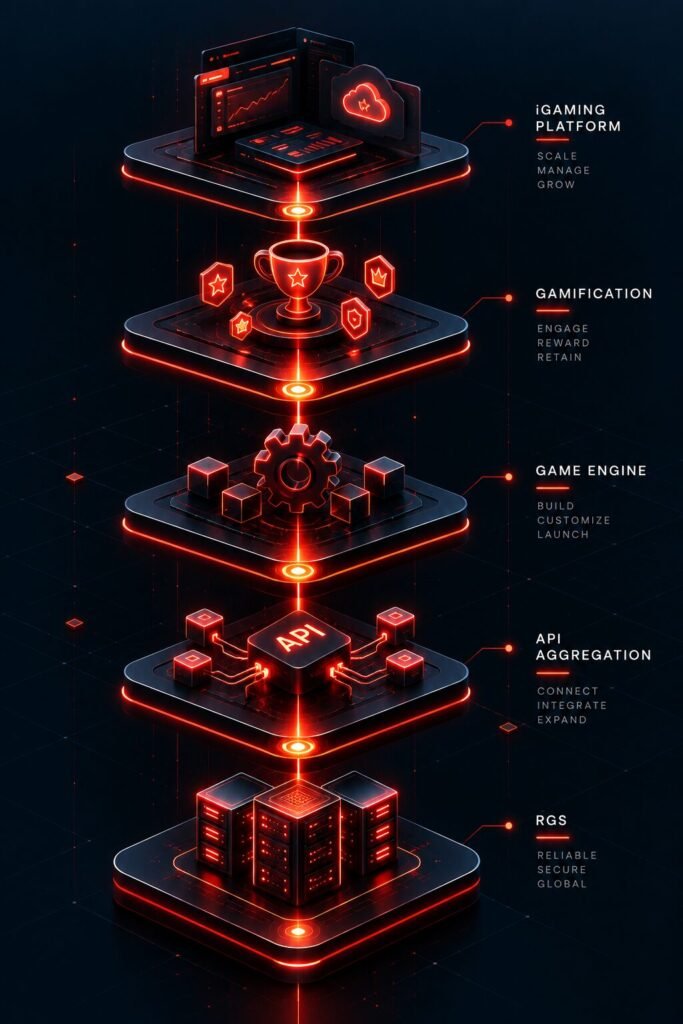
- RGS is the foundation every game and platform runs on.
- API Aggregation feeds outside content into that same foundation without a separate integration for each source.
- Game Engine is how new titles get built on top of the RGS, fast.
- Gamification sits across all of it; missions and tournaments that span RGS-hosted games and aggregated content alike.
- Platforms is the assembled result; the RGS, the aggregated content, the engine-built games, and the gamification layer, running as one product a player actually logs into.
Match Your Role to the Right Solution
RGS, or a full Platform
If you're an operator wanting more control over your tech
API Aggregation
If you're an operator wanting more content, faster
Game Engine
If you're a studio building your next title
Gamification
If you're anyone trying to fix retention
Platforms
If you're anyone launching from scratch
Frequenty Asked Questions.
An RGS is the engine that runs game logic and sessions. A platform is the complete product built around it: player accounts, payments, front-end, and every other solution (aggregation, engine, gamification) assembled together.
Start with whichever gap is actually costing you right now. Most engagements begin with one piece, RGS or gamification are the most common starting points, and expand once the fit is proven.
Yes, the platform architecture is designed to integrate with existing infrastructure where that makes sense, not to force a full rebuild if part of your stack already works.
Yes, it's built to sit across an existing platform and its content, not just platforms built from scratch here.